Sunday, January 28, 2007

Portfolio 28-Jan-2007

My portfolio total gain increase from 76.5% to 81.3% last week. Very much thanks to PBBANK jump from 7.90 to 8.55. At this moment i will not increase my portfolio except for BJTOTO but again is very much depend on how the market will perform next week. I must reckon that is very risky to put your bet right now but when there is an opportunity i will certainly seize it.

Saturday, January 27, 2007

BJTOTO (1562, RM4.64) is worth for a quick trade

My guts feeling this stock is worth for a quick trade, it hasn't move any compare to others blue chip stocks. The upside looks very bright, even if it were to turn south, there is always a dividend to cushion which will be paying somewhere around in April. Worth for a try.


Look at the chart above, high was at $4.98 on 30 Nov 2006 and drifting down after that. At this price should be quite reasonable to enter/accumulate. I would adopt a hit & run approach to ride on this "bull", probably with a higher load this time round as i must agreed the greed has succumbed me right now...he..he


Friday, January 26, 2007

BJTOTO - Another Typical Example

Another typical example on BJTOTO :-

Buy Price : $3.90
Buy Date : 19 Dec 2003
Closed Price as at 27 Jan 2007 : $4.64

Dividend Payout Table :-


* Those highlighted yellow were Capital Repayment.

A) Share price appreciation = 4.64 - 3.90 = 0.74
$740.00

B) Dividend earned + Capital Repayment
$2074.05

C) % return per year
(A + B)/3900 * 100 = 72.15%
72.15% / 3 = 24.05%

Wah Oooo.... a 24.05% per year, what more do you want to ask for ?? Lets imagine this, if i spend $4 a week betting on 4-digits. One year i will be spending a total sum of $208 and losing it if luck was not on my site. What happen if i merely invest $4000 on BJTOTO and i got a return of 24% equivalent to $960 every year. Does this sound better to you ? This ensure you striking 4-digits every year. You risk your money betting on numbers, whereas I'm "betting" on company that invented the number games.......

Monday, January 22, 2007

Worth Keeping The Stock For Long Term ?

How would you get benefited by buying high dividend yielding stock and keeping it for long term?
Take a look of below live example:-

Stock Name : GUINNESS
Buy Price : $4.50
Buy Date : 20/10/2003
Closed Price As At 19/1/2007 : $6.10

Dividend Payout Table :-
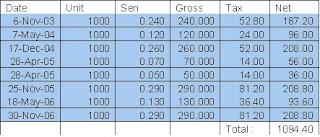

a) Share price appreciation
6.1 – 4.5 = 1.6
$1600.00

b) Total dividend earned
$1094.40

c) % return per annum
(a + b) / 4500 X 100 = 59.88%
59.88% / 3 = 19.96%

Total return per annum is about 19.96%.

So, if you ask me. I would say is worth keeping it but please have the below considerations as your stock criteria before selecting one:-
1) Must be consistently giving out dividend
2) Dividend payout must be at least 5% and above
3) Financially & fundamentally must be solid
4) Have a strategy on the stock picked (e.g averaging downward)
5) Picked a stock that never die/insolvent
6) Last but not least. Do your homework

Monday, January 15, 2007

Portfolio 15-Jan-2007


Ummmm.. This is my first ever portfolio in my blog of year 2007. Finally, i decide to publish it. Some of the stocks I have been keeping it since year 2002. Take a look, will update from time to time whenever there is a movement. I will try to post a more complete one when i have more time to compile one.

Wednesday, January 3, 2007

Financial Savvy - Rule 72

Financial Savvy
1) Rule 72

Definition :-
A simple formula to calculate number of years required for your investment to be doubled.

Example :-
An investment of $1000 with a return of 10 % interest rate.

72
--- = 7.2 years
10

The above scenario requires 7.2 years to double up your investment.

Averaging your investment towards financial freedom

Step 1 - How to save money
(sources from : Rajen Devadason)
“If you want to save more, then having your bank transfer a portion – say, 10% or 20% of your salary to a savings account the moment it hits your main account, is a great way to put saving on autopilot”

Step 2 – Invest intelligently
Concept of investing – when come to investing, an arithmetic anomaly can be harnessed to help build huge wealth over a span of 10, 20, or more years. Often, though not always, the lower the price of a security goes, the safer it is and the greater its value as a potential long term investment.

Step 3 – Investment strategy - DCA
Should meet 6 criteria investment asset before a DCA program is embarked on :-
i) diligence
ii) value of the investment should fluctuate over time
iii) investment time frame should be fairly long. ( 5 to 7 years )
iv) invest at regular intervals (1 a month, 1 a quarter or 1 a year)
v) invest at each of those intervals in equal amount
vi) these regular investments should continue through all kind of market conditions – good, bad and indifferent

Example :-
Let’s say you have $6000 to invest. You have 3 choices :-
a) you do nothing significant & keep money in FD earning 4% a year.
b) You invest full sum into a unit trust or a security
c) You gradually invest $6000 for 12 months.
Conclusion :-

Choice a) $240 earned as interest.

Choice b) 6% earned base on the DCA table. An equivalent of $360.

Choice c),

How DCA works


Arithmetic average price = 5.72 / 12 = 0.4767 per unit
True average cost = 6000 / 12633.88 = 0.4749 per unit
Absolute profit = $695.96
Profit percentage gain = 11.6%

Remarks : I have personally tried this on one of the high dividend yielding stock “APOLLO” and it works. Of course the returns are never guaranteed. Nonetheless, I believe doing so could be the smartest resolution you make. The choice is yours. TQ

Monday, November 27, 2006

ING GLOBAL REAL ESTATE

TO my surprise, this is the only unit trust fund that given me real gains for my investments after being involved in UT investment for the pass 7 years. I have lost confidence all together with any UT fund investment ever since my first investment on UT fund merely gain a poor 2% annually as compare with FD rate of about 3.5%. Many UT agents have approached me and asking more investment in my portfolio. I'm skeptical with that and sharing my past experience with them on my previous investments. Most agents will revert and said; involvement in this should be a long-term engagement & asking them "how long is long". They reverted at least 5 years to get a reasonable return of 7%-8%, but the question is, is 7 years long enough? Why am I only getting a 2% return instead? One of my friend has once told me, he invested UT fund for about 10 years back using EPF scheme but his investment shrunk to almost 50% ever since the launch of the fund. What will this interpret? Was it wrong selection or was it wrong timing? We expect Fund Manager to protect our investment and gain our investment to a reasonable level but it turn out to be an opposite.To my opinion, investment is very much a personal game. We expect others to build our wealth in view of our inadequacy in term of investment knowledge and expertise in investment. I see this as no excuse; we must take control of our own money and make our own decision. Before entering an investment a proper study must be carried out either by asking friends, reading investment news or by other means. Just don't invest when some agents asking you to. To them they just want your money to achieve their quota & hoping that your investment will surge later on for a second possible investment from you. You will probably in a gamble situation where you may either stuck in a non-profit investment for a very long time (probably may not revive) or a 'lucky' gain. I would suggest all to put your money in FD rather than blindly invest if there is no clear sign of your future investments. This is to protect your capital instead of risking it. The above fund has given me a 6.86% return in just 2 months of investment, which I see this is a positive sign for me getting back my UT funds investment confidence. Of course whatever outcome here is very much on your own effort rather than others. BELIEVE IN YOURSELF & YOU CAN DO IT !!!!
Related Posts with Thumbnails