
Friday, April 24, 2009
Scalp on SAAG
Did a quick scalp on SAAG when seeing the opportunity by buying at RM0.24 and disposing them in stages up. Making some quick bucks for weekend money.

Sold All My Maybulk
Just sold off all my Maybulk this morning at RM3.02 after ex-date of 30sen dividend. The reason of selling is simple, i expect EPS for year 2009 to fall and might expect a lower net dividend payout for Maybulk after a generous 30sen div. Thus, trigger my selling idea for now. Will keep monitor this counter until there is clearer earning expected before getting it back.
Meanwhile take a look of it financial summary below:-

Meanwhile take a look of it financial summary below:-

Thursday, April 16, 2009
Sold Half of Zhulian at RM1.14
Manage to dispose half of my holding on ZHULIAN. ZHULIAN has just declared a 1st interim ST dividend of 3sen. ZHULIAN has been giving out dividend on every quarter without failed. Annual % return on div is about 10% based on current price at 1.14. Long term hold and beating FD rate of 3% is anytime from ZHULIAN.....
Take a look of its div payout so far....
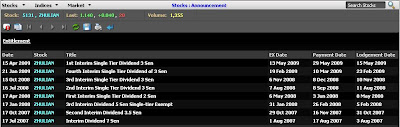
Take a look of its div payout so far....

Wednesday, April 15, 2009

Wednesday, April 8, 2009
More Investors Say Bye-Bye to Buy-and-Hold
Interesting Article, hng, for your reading pleasure.....
By JANE J. KIM
For much of the past decade, Kenneth Kimmons of Bedford, Texas, was a buy-and-hold investor. He regularly socked away money in mutual funds across his 401(k) plans, individual retirement accounts and a brokerage account.
But after watching his investments fall by about 50% last year, he started trading individual stocks and options full-time last fall. He generally buys stocks at the start of the trading day -- lately, it's been bank stocks -- and sells them a few hours later. "I just got tired of putting money away and losing it," says the 31-year-old. He says he's doubled his money since he started trading full-time.
The ups and downs of the market are prompting more retail investors to abandon buy-and-hold strategies in favor of opportunistic trading. Some want more control over their money, so they are fleeing funds and advisers -- not to mention the feelings of helplessness raised by recent months' losses. Some are attempting to recoup their losses, while others are stepping back into the markets after a recent string of stock gains and better-than-expected economic news.
Most financial advisers still believe investors should stay the course, pointing out that frequent trading can incur fees, erode returns and result in higher tax bills. But many individuals have lost faith in the long-term growth of their investments and are trying to make money off the market's volatility.
"When I was younger, I banked on the fact that, over time, stocks will go up, and that if you dollar-cost average [following a fixed schedule of purchases], you'll be fine," says Jim Catalano of Ashburn, Va., who in September rolled over money from an old 401(k) into an IRA at TradeKing, an online brokerage firm with low trading fees. "But my time horizon is getting shorter -- and when you see your 401(k) get chopped in half, I decided I needed to take the reins here and not leave it to the money managers."
Mr. Catalano trades mostly stocks and exchange-traded funds, usually four to five times a week. He writes covered-call option contracts to generate income off his shares, a tactic that could lose him some of the upside if share prices rise substantially. Since he started trading in September, he is down about 5% but has done better than the market.
At the New York Stock Exchange and Nasdaq stock exchanges, turnover levels -- a measure of how often the average share changes hands -- have been rising. At the same time, stock-fund investors sold about 33% of their holdings last year, implying a three-year average holding period, down from a four-year holding period in 2004, according to the Bogle Financial Markets Research Center.
Discount brokerage firms -- including Charles Schwab Corp., TD Ameritrade Holding Corp., E*Trade Financial Corp., ING Groep NV's Sharebuilder and Fidelity Investments -- are seeing record levels of trading activity and new-account openings. Since last September, nearly 7.5 million investors -- or 20% of the online investing community -- have increased trading volume enough to be temporarily reclassified at a higher trading level, says Matthew Bienfang, senior research director at TowerGroup.
More Investors Ramp Up Trading
More buy-and-hold investors are changing tactics. Here are some factors to consider:
Trading activity and new account openings are hitting highs as average holding periods decline.More investors are trying to take advantage of market volatility, which they expect to continue.Active trading can erode returns as investors get hit with higher trading costs and taxes."Typically in a bear market, you'll see a retraction of activity and reduction of people opening new accounts," says Jay Pestrichelli, managing director at TD Ameritrade. "This time around, somebody forgot to tell the retail client that's what happens."
Some market experts say retail investors are likely to make a bad situation even worse. "It's a fools' game," says John Bogle, the 79-year-old founder of mutual-fund giant Vanguard Group, which helped popularize index funds and the virtues of buy-and-hold investing. Not only will short-term investors pay more commissions, fees and other costs, but various studies have shown that market timers typically lose more money than buy-and-hold investors. "If you want to trade the market, you've got to be right twice -- you've got to get out and get back in," he says.
But others say things are different this time. "The problem I have with the buy-and-hold strategy is that it's a bull-market strategy," say Matthew Tuttle, a financial adviser in Stamford, Conn. "In the bust, you give all of your profits back." Mr. Tuttle has recently taken a more active approach to trading. While short-term investors are likely to face higher tax bills -- since short-term gains are taxed at higher rates than long-term gains -- he notes that some people who incurred big losses last year will be able to carry those losses forward to offset taxes in future years.
"The psychology of the market is broken," says Michael Parness, who runs Trendfund.com, which dispenses trading advice online. "People just don't trust it." As a result, many of the market's moves are "almost entirely based on whatever news is coming out of the government," he says.
The uncertain environment has prompted David Dilley of Bonita Springs, Fla., to trade more frequently. The 76-year-old retiree believes there has been a "sea change" in economic philosophy -- shifting from private enterprise to a command-and-control economy. "The long-term market gains that we've had in the past will not occur until that reverts and we get back free enterprise," he says. So, while he had considered himself a longtime buy-and-hold investor, he's now trading Canadian oil trusts in his E*Trade account several times a week. Mr. Dilley didn't provide exact numbers but says he's beating the broader market averages so far this year.
In another sign that investors are getting more speculative, the most widely held stocks in investors' accounts at discount brokerage firms Sharebuilder, TradeKing and Firstrade Securities Inc. are the same ones that are under the most pressure, including Citigroup Inc., American International Group Inc., Ford Motor Co., General Electric Co., and Bank of America Corp. By contrast, the most popular stocks a year ago were Apple Inc., Google Inc., Microsoft Corp. and the like.
"We see a lot of people trying to ride the waves of stocks with no long-term vision," says TradeKing Chief Executive Don Montanaro. "They're so low-priced -- and it's nothing for these stocks to move 40% or 50% in a week."
Sue Cirillo of Pelham Manor, N.Y., used to hold on to household names such as Apple. But last fall, she sold some of her longtime holdings, moved to cash and started trading. "The difference between now and then is that when I've made money, I take it off the table and look for the next opportunity," says the 47-year-old music producer. "Before, I was more focused on companies that I felt were going to be profitable." Now, she pays attention to daily market swings, subscribes to online advice services such as Mr. Parness's for trading ideas, and has recently learned to short stocks.
Mark Swenson of southern New Hampshire says he typically trades with exchange-traded funds, instead of buying individual stocks. The 40-year-old says he started trading for the first time last October, in part to generate additional income in case his work as a plumber dried up. Although he says he got "slaughtered" when he first started trading, he says that he has since made up much of that initial loss and that it's easier for him to trade than do nothing.
"I could no longer stomach it -- watching my money disappear," he says. "For right now, it's a traders' market. Until I get the sense that the market is on the rise, I generally don't plan on doing any buying and holding -- not for the long term."
Others got tired of paying their advisers. Last June, Linda Smith of Denver fired her broker, saying it was a waste of money to pay her adviser 1.5% in annual fees for picking mutual funds she believed she could pick herself. "No one on this planet knows better what to do with my finances than me," says the 53-year-old.
For the year, she figures her portfolio is up about 5%, including the interest from her CDs. "Nobody can time the market 100% correctly 100% of the time," she says. "However, that doesn't mean you can't get lucky now and then."
By JANE J. KIM
For much of the past decade, Kenneth Kimmons of Bedford, Texas, was a buy-and-hold investor. He regularly socked away money in mutual funds across his 401(k) plans, individual retirement accounts and a brokerage account.
But after watching his investments fall by about 50% last year, he started trading individual stocks and options full-time last fall. He generally buys stocks at the start of the trading day -- lately, it's been bank stocks -- and sells them a few hours later. "I just got tired of putting money away and losing it," says the 31-year-old. He says he's doubled his money since he started trading full-time.
The ups and downs of the market are prompting more retail investors to abandon buy-and-hold strategies in favor of opportunistic trading. Some want more control over their money, so they are fleeing funds and advisers -- not to mention the feelings of helplessness raised by recent months' losses. Some are attempting to recoup their losses, while others are stepping back into the markets after a recent string of stock gains and better-than-expected economic news.
Most financial advisers still believe investors should stay the course, pointing out that frequent trading can incur fees, erode returns and result in higher tax bills. But many individuals have lost faith in the long-term growth of their investments and are trying to make money off the market's volatility.
"When I was younger, I banked on the fact that, over time, stocks will go up, and that if you dollar-cost average [following a fixed schedule of purchases], you'll be fine," says Jim Catalano of Ashburn, Va., who in September rolled over money from an old 401(k) into an IRA at TradeKing, an online brokerage firm with low trading fees. "But my time horizon is getting shorter -- and when you see your 401(k) get chopped in half, I decided I needed to take the reins here and not leave it to the money managers."
Mr. Catalano trades mostly stocks and exchange-traded funds, usually four to five times a week. He writes covered-call option contracts to generate income off his shares, a tactic that could lose him some of the upside if share prices rise substantially. Since he started trading in September, he is down about 5% but has done better than the market.
At the New York Stock Exchange and Nasdaq stock exchanges, turnover levels -- a measure of how often the average share changes hands -- have been rising. At the same time, stock-fund investors sold about 33% of their holdings last year, implying a three-year average holding period, down from a four-year holding period in 2004, according to the Bogle Financial Markets Research Center.
Discount brokerage firms -- including Charles Schwab Corp., TD Ameritrade Holding Corp., E*Trade Financial Corp., ING Groep NV's Sharebuilder and Fidelity Investments -- are seeing record levels of trading activity and new-account openings. Since last September, nearly 7.5 million investors -- or 20% of the online investing community -- have increased trading volume enough to be temporarily reclassified at a higher trading level, says Matthew Bienfang, senior research director at TowerGroup.
More Investors Ramp Up Trading
More buy-and-hold investors are changing tactics. Here are some factors to consider:
Trading activity and new account openings are hitting highs as average holding periods decline.More investors are trying to take advantage of market volatility, which they expect to continue.Active trading can erode returns as investors get hit with higher trading costs and taxes."Typically in a bear market, you'll see a retraction of activity and reduction of people opening new accounts," says Jay Pestrichelli, managing director at TD Ameritrade. "This time around, somebody forgot to tell the retail client that's what happens."
Some market experts say retail investors are likely to make a bad situation even worse. "It's a fools' game," says John Bogle, the 79-year-old founder of mutual-fund giant Vanguard Group, which helped popularize index funds and the virtues of buy-and-hold investing. Not only will short-term investors pay more commissions, fees and other costs, but various studies have shown that market timers typically lose more money than buy-and-hold investors. "If you want to trade the market, you've got to be right twice -- you've got to get out and get back in," he says.
But others say things are different this time. "The problem I have with the buy-and-hold strategy is that it's a bull-market strategy," say Matthew Tuttle, a financial adviser in Stamford, Conn. "In the bust, you give all of your profits back." Mr. Tuttle has recently taken a more active approach to trading. While short-term investors are likely to face higher tax bills -- since short-term gains are taxed at higher rates than long-term gains -- he notes that some people who incurred big losses last year will be able to carry those losses forward to offset taxes in future years.
"The psychology of the market is broken," says Michael Parness, who runs Trendfund.com, which dispenses trading advice online. "People just don't trust it." As a result, many of the market's moves are "almost entirely based on whatever news is coming out of the government," he says.
The uncertain environment has prompted David Dilley of Bonita Springs, Fla., to trade more frequently. The 76-year-old retiree believes there has been a "sea change" in economic philosophy -- shifting from private enterprise to a command-and-control economy. "The long-term market gains that we've had in the past will not occur until that reverts and we get back free enterprise," he says. So, while he had considered himself a longtime buy-and-hold investor, he's now trading Canadian oil trusts in his E*Trade account several times a week. Mr. Dilley didn't provide exact numbers but says he's beating the broader market averages so far this year.
In another sign that investors are getting more speculative, the most widely held stocks in investors' accounts at discount brokerage firms Sharebuilder, TradeKing and Firstrade Securities Inc. are the same ones that are under the most pressure, including Citigroup Inc., American International Group Inc., Ford Motor Co., General Electric Co., and Bank of America Corp. By contrast, the most popular stocks a year ago were Apple Inc., Google Inc., Microsoft Corp. and the like.
"We see a lot of people trying to ride the waves of stocks with no long-term vision," says TradeKing Chief Executive Don Montanaro. "They're so low-priced -- and it's nothing for these stocks to move 40% or 50% in a week."
Sue Cirillo of Pelham Manor, N.Y., used to hold on to household names such as Apple. But last fall, she sold some of her longtime holdings, moved to cash and started trading. "The difference between now and then is that when I've made money, I take it off the table and look for the next opportunity," says the 47-year-old music producer. "Before, I was more focused on companies that I felt were going to be profitable." Now, she pays attention to daily market swings, subscribes to online advice services such as Mr. Parness's for trading ideas, and has recently learned to short stocks.
Mark Swenson of southern New Hampshire says he typically trades with exchange-traded funds, instead of buying individual stocks. The 40-year-old says he started trading for the first time last October, in part to generate additional income in case his work as a plumber dried up. Although he says he got "slaughtered" when he first started trading, he says that he has since made up much of that initial loss and that it's easier for him to trade than do nothing.
"I could no longer stomach it -- watching my money disappear," he says. "For right now, it's a traders' market. Until I get the sense that the market is on the rise, I generally don't plan on doing any buying and holding -- not for the long term."
Others got tired of paying their advisers. Last June, Linda Smith of Denver fired her broker, saying it was a waste of money to pay her adviser 1.5% in annual fees for picking mutual funds she believed she could pick herself. "No one on this planet knows better what to do with my finances than me," says the 53-year-old.
For the year, she figures her portfolio is up about 5%, including the interest from her CDs. "Nobody can time the market 100% correctly 100% of the time," she says. "However, that doesn't mean you can't get lucky now and then."
Wednesday, March 25, 2009
Swapping PBB-F back to PBBANK again
Have managed to swap all my PBBANK-F at a price of RM7.55 to PBBANK at RM7.40, this is the similar swapping that i did previously in last December08 by swapping from PBB to PBB-F when there is margin of profit. Now i just did it the other way round (swapped PBB-F for PBB). Of course by doing so will in turn giving some contra money to me (the price different between both shares). Will repeat the same method if PBB price surpassing PBB-F in near future.
Tuesday, March 24, 2009

A behaviourial reminder
Making your money work
By JOYCE CHUAH
Pitfalls to avoid when making an investment.
LET’S face it. No investment decision will be right all the time. It is through wrong investment decisions that we make the right decisions eventually. So it is important to discuss some of the reasons why investments fail.
Often, emotional response is the culprit behind bad investment decisions. One of the most common emotional responses is the herd mentality. It is easy to follow the herd. We prefer to chase after the most talked about stocks, or follow the latest investment “guru”. When trouble looms, the herd mentality often kicks in. When everyone else is nervous about the market, so are we. We forget about our investment strategies, preferring to run instead of holding on for long-term returns.
Following the herd will mean you need to change course each time, and this will take you longer to reach your goal.
So what can you do? Draw up your own investment philosophy. Investment philosophies are like promises you want to make to yourself and investment behaviours you wish to inculcate.
Here are 10 of the most common investment mistakes:
1. Investing at the peak of an economic cycle.
It is always easier to invest when everything looks rosy, when confidence is high and your friends tell you they are making money. Worse of all, when you join in the fray, the bubble bursts. So what do you do? You decide to stay out and let the investment value ride back up to recoup your capital. The problem is if you invested at the peak of the cycle, it may be another five to eight years’ time before you see it peak again.
2. Taking advice from an “accurate source.”
Most investment losses can be attributed to following third party “hot tips” and advice without doing homework. Some even claim they had insider information or that the news came from the horse’s mouth. If it sounds too good to be true, it usually isn’t true!
3. Afraid to value cost when returns are negative.
Value cost averaging is one strategy to average your cost and lower your investment’s break-even point. For this strategy to work, you must have enough funds to value cost, give your investment vehicle enough time to come back up again, and most importantly, your investment vehicle must have the capability to rise in value eventually.
This strategy is useful in investments which are diversified in nature, like managed funds, as they will not lose all of their value even in the worst market scenario. If you are investing in stocks with good value prospects, be prepared to value average too.
4. Unaware of the status of investments.
Many investors know exactly when their fixed deposits are maturing but have no idea when it comes to their more volatile and growth-oriented investments. Investments must be tracked more regularly than fixed income vehicles and knowing their value and how they have performed over time helps you to seize opportunities to sell or accumulate more for value averaging purposes. However, do not monitor your investments too frequently as it can cause you to panic and sell your winners too soon.
5. Not having a required rate of return.
Investors often do not set a target of return for their investments. Even if they do, they shift their targets as greed sets in, especially in a bullish market. This can be dangerous as a sudden event in the market can wipe out profits. What one needs to do in a bullish market is to sell the profits when the desired rate of return is met and continue to monitor the capital for further market upsides. However, if you are a new or conservative investor, it is be better to realise both your profits and capital once your “triple R” (Required Rate of Return) is met.
6. Not rebalancing portfolios.
During the 2003 Iraq war, an investor announced that his investment planner had told him to switch his equity portfolios to bonds as the war could be a potential danger to his exposure to equities. I met the same investor again at the end of 2003. He said he had lost about 15% in his bond investments in the 2003 bond market crash.
Unfortunately for him, rebalancing portfolios was done as a single isolated event. He had forgotten that rebalancing must be done consistently in different cycles under which the specific investments are exposed to. My advice is to rebalance at the most twice a year, unless a sudden unexpected event happens.
7. Focus on popular investments.
Investors feel better when they invest in investments which have been highly publicised, advertised or the ones everyone else is getting into. Some of these are good investments and are worth looking into but do your homework. Check if they suit your investment goals and time-frame.
8. Focusing on “guaranteed” investments.
Having your capital guaranteed is fine but you need to realise what they are “guaranteeing” – capital or returns? This promise of “capital guarantee” usually deceives us in our understanding of balancing the cost of other investment opportunities during the holding period against the security of not losing our capital at the end of the tenure. Putting money into a guaranteed fund is only suitable if you do not need the funds within the holding period and you have a diversified investment portfolio.
9. Not having an investment philosophy.
An investment philosophy is just a simple statement of your investment style, what allocations you have determined for your investments, which investments you want to include in your portfolio and those you do not want to be included at all. The statement also outlines your purpose in investing, strategies to be undertaken should your investments go wrong, and the time-frame you have set aside for each investment. Your philosophy can be adjusted to suit the current scenario. Having an investment philosophy prevents us from being overly-greedy or overly fearful.
10. Transactional type of investments.
For most of us, the only purpose we invest is to make money. After that, what next? We need to have a purpose for our investments. Why did we invest in stocks, unit trusts and property? To make money? Yes, but what’s the purpose behind that purpose? Your investments must be purpose-driven, for example, to clear debts, fund a comfortable retirement, or to send your kids to college. Remember, greed is not a purpose.
Joyce Chuah is a Financial Intelligence trainer and Certified Financial Planner who has been in the industry for 10 years.
By JOYCE CHUAH
Pitfalls to avoid when making an investment.
LET’S face it. No investment decision will be right all the time. It is through wrong investment decisions that we make the right decisions eventually. So it is important to discuss some of the reasons why investments fail.
Often, emotional response is the culprit behind bad investment decisions. One of the most common emotional responses is the herd mentality. It is easy to follow the herd. We prefer to chase after the most talked about stocks, or follow the latest investment “guru”. When trouble looms, the herd mentality often kicks in. When everyone else is nervous about the market, so are we. We forget about our investment strategies, preferring to run instead of holding on for long-term returns.
Following the herd will mean you need to change course each time, and this will take you longer to reach your goal.
So what can you do? Draw up your own investment philosophy. Investment philosophies are like promises you want to make to yourself and investment behaviours you wish to inculcate.
Here are 10 of the most common investment mistakes:
1. Investing at the peak of an economic cycle.
It is always easier to invest when everything looks rosy, when confidence is high and your friends tell you they are making money. Worse of all, when you join in the fray, the bubble bursts. So what do you do? You decide to stay out and let the investment value ride back up to recoup your capital. The problem is if you invested at the peak of the cycle, it may be another five to eight years’ time before you see it peak again.
2. Taking advice from an “accurate source.”
Most investment losses can be attributed to following third party “hot tips” and advice without doing homework. Some even claim they had insider information or that the news came from the horse’s mouth. If it sounds too good to be true, it usually isn’t true!
3. Afraid to value cost when returns are negative.
Value cost averaging is one strategy to average your cost and lower your investment’s break-even point. For this strategy to work, you must have enough funds to value cost, give your investment vehicle enough time to come back up again, and most importantly, your investment vehicle must have the capability to rise in value eventually.
This strategy is useful in investments which are diversified in nature, like managed funds, as they will not lose all of their value even in the worst market scenario. If you are investing in stocks with good value prospects, be prepared to value average too.
4. Unaware of the status of investments.
Many investors know exactly when their fixed deposits are maturing but have no idea when it comes to their more volatile and growth-oriented investments. Investments must be tracked more regularly than fixed income vehicles and knowing their value and how they have performed over time helps you to seize opportunities to sell or accumulate more for value averaging purposes. However, do not monitor your investments too frequently as it can cause you to panic and sell your winners too soon.
5. Not having a required rate of return.
Investors often do not set a target of return for their investments. Even if they do, they shift their targets as greed sets in, especially in a bullish market. This can be dangerous as a sudden event in the market can wipe out profits. What one needs to do in a bullish market is to sell the profits when the desired rate of return is met and continue to monitor the capital for further market upsides. However, if you are a new or conservative investor, it is be better to realise both your profits and capital once your “triple R” (Required Rate of Return) is met.
6. Not rebalancing portfolios.
During the 2003 Iraq war, an investor announced that his investment planner had told him to switch his equity portfolios to bonds as the war could be a potential danger to his exposure to equities. I met the same investor again at the end of 2003. He said he had lost about 15% in his bond investments in the 2003 bond market crash.
Unfortunately for him, rebalancing portfolios was done as a single isolated event. He had forgotten that rebalancing must be done consistently in different cycles under which the specific investments are exposed to. My advice is to rebalance at the most twice a year, unless a sudden unexpected event happens.
7. Focus on popular investments.
Investors feel better when they invest in investments which have been highly publicised, advertised or the ones everyone else is getting into. Some of these are good investments and are worth looking into but do your homework. Check if they suit your investment goals and time-frame.
8. Focusing on “guaranteed” investments.
Having your capital guaranteed is fine but you need to realise what they are “guaranteeing” – capital or returns? This promise of “capital guarantee” usually deceives us in our understanding of balancing the cost of other investment opportunities during the holding period against the security of not losing our capital at the end of the tenure. Putting money into a guaranteed fund is only suitable if you do not need the funds within the holding period and you have a diversified investment portfolio.
9. Not having an investment philosophy.
An investment philosophy is just a simple statement of your investment style, what allocations you have determined for your investments, which investments you want to include in your portfolio and those you do not want to be included at all. The statement also outlines your purpose in investing, strategies to be undertaken should your investments go wrong, and the time-frame you have set aside for each investment. Your philosophy can be adjusted to suit the current scenario. Having an investment philosophy prevents us from being overly-greedy or overly fearful.
10. Transactional type of investments.
For most of us, the only purpose we invest is to make money. After that, what next? We need to have a purpose for our investments. Why did we invest in stocks, unit trusts and property? To make money? Yes, but what’s the purpose behind that purpose? Your investments must be purpose-driven, for example, to clear debts, fund a comfortable retirement, or to send your kids to college. Remember, greed is not a purpose.
Joyce Chuah is a Financial Intelligence trainer and Certified Financial Planner who has been in the industry for 10 years.
Monday, March 23, 2009
Sold Bursa at RM5.05

Sold all my BURSA for RM5.05 that gotten at RM5 and make some tiny lunch money.
Friday, March 20, 2009
Received 4th Interim Dividend 3sen from ZHULIAN

Just gotten the 4th Interim Dividend of 3sen from Zhulian. Dividend has been paid on every quarter so far. Take a look of it div history.
Friday, March 13, 2009
Received Dividend From PBBANK-01 & IOICORP


Just received 25% div and share div of 1:35 from PBBANK-01, and 30% div from IOICORP. Take a look of their div history as well....
Wednesday, February 25, 2009


Friday, February 20, 2009
Bought BURSA at RM5.00
Matched BURSA at RM5.00 just right before pre-open/close in the afternoon session.
Monday, February 16, 2009
Received 7sen Dividend From BJTOTO
Just received my 7sen dividend from BJTOTO. This is the second dividend received so far beside Panamy, there are more dividends to come if one stick to dividend play i believed.
Every quarter without failed, i am being rewarded with small fortune like this, its just like striking a lottery of consolation price and the best part of it is being paid every quarterly without failed. Keep up the good work dear "toto", you will be my life partner till you dry up. he he he.....
Every quarter without failed, i am being rewarded with small fortune like this, its just like striking a lottery of consolation price and the best part of it is being paid every quarterly without failed. Keep up the good work dear "toto", you will be my life partner till you dry up. he he he.....
Thursday, February 12, 2009
Sold TENAGA @ RM6.00 for Intraday Gain
Sold all Tenaga at RM6.00 that gotten at RM5.90 just a while ago for intraday gain. Not a bad day for me today in fact.
Bought Tenaga (5347) at RM5.90
Bought back Tenaga at RM5.90. Price swing quite drastically from 6.15 back to 5.80 and now. If one adopt swing trade should reap quite a fair bit.
Sold TENAGA @ RM6.05
This morning sold all my Tenaga at RM6.05 that gotten at RM5.80 the other day. Will try buy back at around RM5.90 if possible.
Tuesday, February 3, 2009
Bought Tenaga (5347) at RM5.80
Gotten myself Tenaga at RM5.80 this morning. Market looks unsteadily drifting downward.
Saturday, January 31, 2009
Received 15sen Dividend from PANAMY
Just received 15sen dividend from PANAMY, 4th Quarter dividend is around July and likely to be RM1.00 as well. This is my first dividend in ox year of 2009.
Year 2008 indeed not a bad year for me after all, my total investment return is about 13%. So coincidently that, this percentage return is the same compare to year 2006 and 2007. Overall quite satisfied with the result as the figure is almost double the one in year 2005 where i merely get around 7%. This indeed a good run considering being a part timer like me. It is a much higher return comparing with FD.
No doubt this year is a tough year, i wish everyone work hard like ox and may your wish come true. Happy trading....
Year 2008 indeed not a bad year for me after all, my total investment return is about 13%. So coincidently that, this percentage return is the same compare to year 2006 and 2007. Overall quite satisfied with the result as the figure is almost double the one in year 2005 where i merely get around 7%. This indeed a good run considering being a part timer like me. It is a much higher return comparing with FD.
No doubt this year is a tough year, i wish everyone work hard like ox and may your wish come true. Happy trading....
Subscribe to:
Posts (Atom)
